
- Home
- Our School
- Admissions
- Early Years: Nursery & Reception
- Curriculum
- Our Curriculum Intent & Implementation
- Curriculum by Subject
- Collective Worship
- Home Learning – Overview
- Curriculum by Year Group
- Parents
- News
Geography


Intent
At Waterfield, we believe that a high-quality geography education should inspire in pupils a curiosity and fascination about the world that will remain with them for the rest of their lives. We believe that there can be few things more fundamental than learning about the ‘Earth as our home’. Geography also deepens understanding of many contemporary challenges – climate change, food security, energy choices. As a subject, it impacts upon every aspect of our children’s lives and plays a crucial role in developing caring and understanding citizens of tomorrow. At Waterfield we want children to realise that geography is about them, growing up in their world. We want to build on children’s interests and experiences but also find ways to challenge and excite them with content that might be beyond their immediate horizon. We have carefully selected units which reflect the needs of our children: units which enable them to fully appreciate and understand the local area of the Millpond and units that take them beyond the local area to explore the UK and the wider world.
Implementation
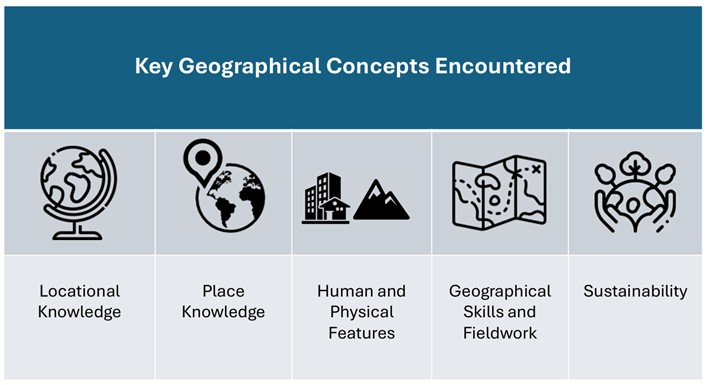
The teaching and learning of Geography are underpinned by key concepts that serve as a foundation to develop knowledge and enquiry-based skills. Based on the National Curriculum, learning across the school is structured in a way that ensures previous learning is revisited and built upon to create links and deepen understanding. Our local environment is used to provide practical learning opportunities. As geographers, children view the world using the key concepts as a lens to focus their learning. These key concepts are:
In EYFS, children explore places and all the things within them such as trees in the natural environment and roads and traffic in the built environment. They are encouraged to ask questions, consider similarities and differences between locations, and explain their thinking.
In KS1 children investigate their locality by asking questions and using fieldwork including observation. Children identify the countries and capitals of the United Kingdom, exploring these further by using maps and aerial photographs to identify key physical and human features. Understanding geography on a global scale, children learn about the world’s continents and oceans, and compare and contrast the United Kingdom with a non-European country. All the while this cumulative knowledge is building and rooted in our very own locality – with core facts and vocabulary building upon one another.
In KS2, children expand their geographical vocabulary and world knowledge by identifying the geographic zones and locating the world’s countries. They explore geographical similarities and differences of physical geography such as rivers, mountains and volcanoes, and human geography including settlements, land use and economic activity. They utilise maps, globes and computer mapping, and study these in greater depth. Alongside this, children use a range of sources and fieldwork to observe, measure and record the human and physical features in the local area using a range of methods.
View our Progression Map for Geography.